Discover Finikounta and the Gems of Messinia
Sights, beaches, villages, and experiences you shouldn’t miss on your trip.
The complete travel guide to experience the magic of the region.
Beaches
- Loutsa Beach
Loutsa Beach lies in front of the small settlement of Loutsa. It consists mainly of sand and pebbles, and as you enter the sea, you’ll need to walk over large pebbles on the seabed.
On the beach, you’ll find sunbeds as well as traditional fish tavernas.
The waters are icy cold and crystal clear, while the view is magical.
Located 1.5 kilometers east of Finikounta.
Finikounta Beach
Finikounta Beach is located directly in front of the village of Finikounta, in the southern part of Messinia.It has been awarded a Blue Flag for its cleanliness, is sandy, and features clear, turquoise waters. The shallow depth makes it an ideal destination for families with small children.
It is quite well organized, with cafés offering umbrellas and sunbeds along almost its entire length.
- Anemomylos Beach
Anemomylos Beach is a very large beach with different names along its length. It has beautiful, clean waters with stunning views and has also been awarded a Blue Flag.
It’s popular with surfers, as it has designated surfing areas. Along its length, there are canteens and beach bars that operate at intervals and offer umbrellas and sunbeds in a relaxed, family-friendly atmosphere.
- Lampes Beach
Just a few kilometers from Finikounta on the road to Methoni, you’ll find the beautiful Lampes Beach, with fine sand and shallow waters.Ideal for families with young children, it features canteens, restaurants, and beach bars offering umbrellas and sunbeds across most of its length.
- Methoni Beach
Methoni Beach is located in Methoni, the castle town of Messinia. One part of the beach is sandy, while the eastern side is covered with pebbles.
It’s wide and long, offering a relaxing swim with views of the islet of Sapientza and, of course, the famous Methoni Castle—one of the most significant monuments in Messinia.
- Kantouni Beach
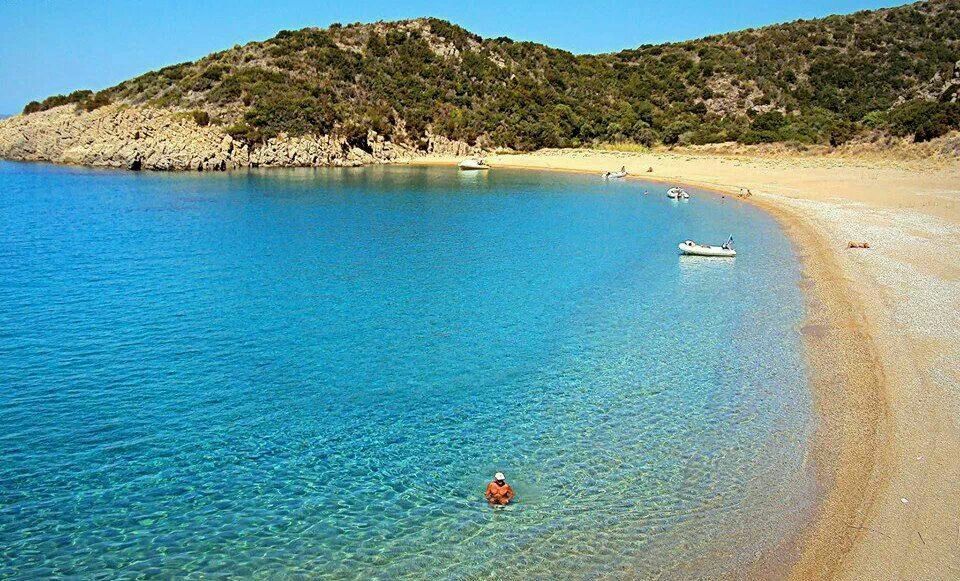
Kantouni Beach lies east of Loutsa, just before Finikounta. It is one of the secluded beaches of the area, with difficult access.
It’s a small sandy cove in a breathtaking setting, surrounded by cliffs that hang dramatically on either side.Sea access is possible.
- Small and Big Marathi Beach
You’ll spot them on the map—but make sure you fully understand the route before you begin. Three kilometers of rough dirt road and plenty of dust will test your endurance, but the reward is more than worth it.
The journey takes you through a magical landscape, just a breath away from Cape Akrita. A beautiful olive grove welcomes you, and beneath its shade, the discomfort of the trip is instantly forgotten.
As for the beach? A dream worth the effort and even a night’s stay.Sea access is possible.
- Voidokilia Beach
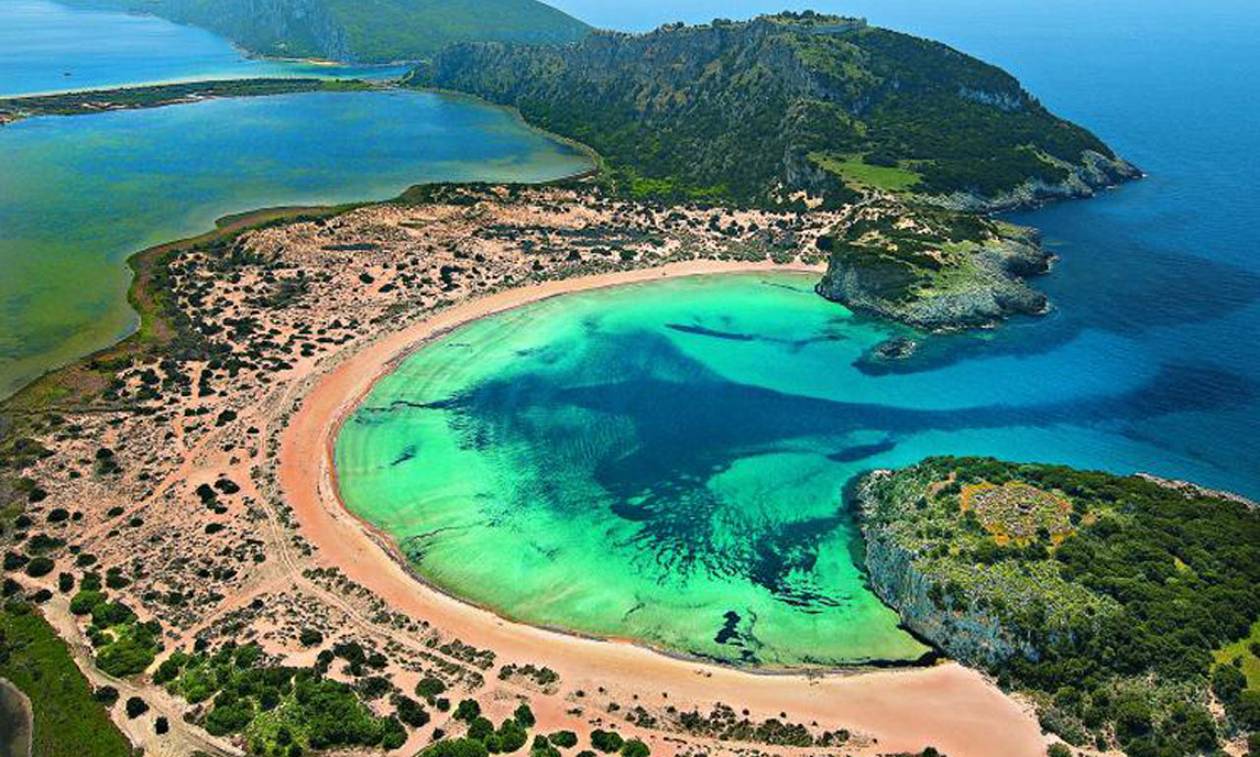
Voidokilia Beach lies on the western side of Messinia, a few kilometers north of beautiful Pylos. It is undoubtedly one of the most stunning beaches in Greece, known for its perfectly circular shape, golden sand, and turquoise waters.
The beach is as remote as needed to remain “authentic”! It is located in a protected Natura 2000 zone. You won’t find any organized facilities. In August, however, it gets busy with hundreds of visitors who come to admire and enjoy its waters and landscape.
Free camping is prohibited in the area, which is rich in biodiversity. - Zaga Beach
Zaga Beach is a long, seemingly endless sandy beach that begins at the southern end of Koroni Castle and stretches westward toward the road to Finikounta.
Many families and young people choose this beach for its fine sand and turquoise waters. Along Zaga Beach, you’ll find several organized spots with umbrellas, sunbeds, and options for water sports. There are also campgrounds, beach bars, beach volleyball and soccer courts, showers, and changing rooms.
Zaga Beach is also accessible via the Eleistra Monastery in Koroni.
- Tsapi Beach
It is a truly remote and beautiful spot, far from the usual tourist traps. In Tsapi’s small beach of just 100 meters, you’ll find one taverna, a small campsite with 45 spaces, and a few houses nestled in a charming valley.
The beach is sandy, and the sea here is deep.Tsapi Beach is a stunning location in Messinia with crystal-clear waters, found 7 kilometers off the Finikounta–Koroni regional road. You’ll see a sign near the coastal road in the area of Chrysokellaria.
Sights
- Methoni Castle
Methoni Castle, covering approximately 93 acres, is one of the most important fortification complexes in the Mediterranean. It occupies a narrow peninsula about 500 meters long, with a small harbor formed on its eastern side.
The castle consists of two sections: the southern area houses the main town enclosed by a wall with towers at intervals, while the northern rocky part forms the acropolis. - Pylos Castle
Niokastro of Pylos is an Ottoman fortress located next to the modern town of Pylos in southwestern Messinia. It is one of two castles that guarded the strategic Bay of Navarino (also known as the Gulf of Pylos).
Niokastro stands at the southern entrance of the bay, while the northern entrance was guarded by Paleokastro Navarino, a 13th-century Frankish fortress built atop the promontory of Coryphasium (then known as Cape Zonklon), by crusaders from the Principality of Achaea. - Koroni Castle
Koroni Castle is the least well-preserved among the major castles of the area. Built during Byzantine times, it underwent many modifications by each conquering power.
After the Frankish conquest of Koroni, the castle was granted as a fief to the Villehardouin family. In 1206, the Venetians succeeded in conquering Koroni as part of their search for new naval trade stations. Their dominance was solidified between 1209 and 1265 under Doge Michele. The Venetians organized the town’s life and administration while also reinforcing the castle. - Ancient Messene
Ancient Messene was a historic city in southern Peloponnese, located near today’s village of Ancient Messini (previously called Mavrommati Ithomis until 2002).
It was founded in the winter of 370–369 BC by the Theban general Epaminondas and is one of Greece’s most important archaeological sites.It is an expansive archaeological park, where visitors can admire the remains of temples, houses, city walls, and public buildings, many of which are well-preserved and impressive in scale.
- Palace of Nestor
The Palace of Nestor is a central palace from the Late Helladic (Mycenaean) Period, surrounded by a fortified enclosure.
It was a two-story building that included storage rooms, workshops, baths, banquet halls, reception areas, and a central drainage system. It is located on the prominent hill of Epano Englianos.
It is considered the best-preserved Mycenaean palace discovered to date. - Gialova Lagoon
The Gialova Lagoon (also known as Divari) is located about 8 kilometers north of Pylos. It is a protected natural and cultural reserve covering around 6,000 stremmas (~600 hectares).
Its waters are brackish and shallow (less than one meter deep), and the area hosts dozens of microhabitats including reed beds, tidal mudflats, cedar forests, sandy beaches, vertical cliffs, underwater canals, small reedbeds, and thyme-covered plains. - Kalamaris Waterfalls
The Kalamaris Waterfall is located near Schoinolakka, just a few kilometers from the Gialova Lagoon, in northwestern Pylia.
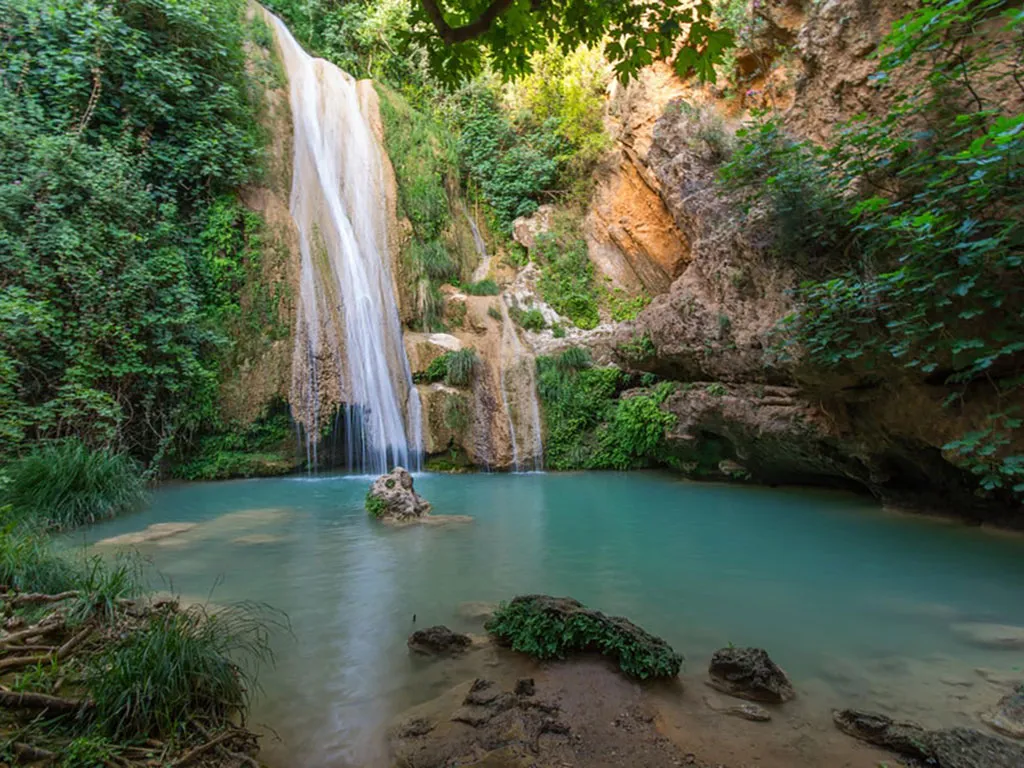
It is a small waterfall in a densely wooded slope, a typical example of a micro aquatic ecosystem.
The waterfall has a height of about 20 meters and forms a small shallow pond at its base, home to many amphibians and water insects. - Polylimnio Waterfalls
Polylimnio is located in the region of Messinia, in the community of Charavgi of the Municipality of Messini. It is a cluster of lakes connected by waterfalls, created by the region’s uneven terrain.
It is a small hidden paradise, recently gaining wider popularity as more visitors discover it as a perfect nature hike destination. - Paleokastro (Old Castle)
Paleokastro has a history spanning thousands of years as it was the fortified acropolis of ancient Pylos. Heroic battles took place here during the Peloponnesian War and in subsequent centuries. The castle was besieged and occupied at different times by the Franks, Spaniards, Turks, Venetians, and eventually liberated by the Greeks in 1828.
It is worth visiting not only for its rich history but also for the stunning panoramic view it offers.
To the north, you’ll see Voidokilia Beach and Romanou Beach. Just behind Voidokilia lies the Gialova Lagoon nature reserve.
To the south and southeast, you’ll spot the island of Sphacteria and the town of Pylos, while to the west, the Ionian Sea stretches to the horizon! - Sapientza
Sapientza is the second largest island of the Messenian Oinousses after Schiza. It is located off the southwestern coast of Messinia, across from Methoni, and is a lush, unspoiled island with rare flora. Its highest point reaches 219 meters. Access is via tourist boats departing from Methoni. Along its coasts, several shipwrecks have been recorded—some of which carried precious cargo, now of great archaeological importance. One such shipwreck contained columns from a grand colonnade built by Herod in Caesarea of Palestine in the 1st century AD, while another held significant Roman sarcophagi.